Difference between session fixation and session hijacking
Attackers force you to use their chosen identifier before login, bypassing the randomisation that usually protects your active connection to a web application.

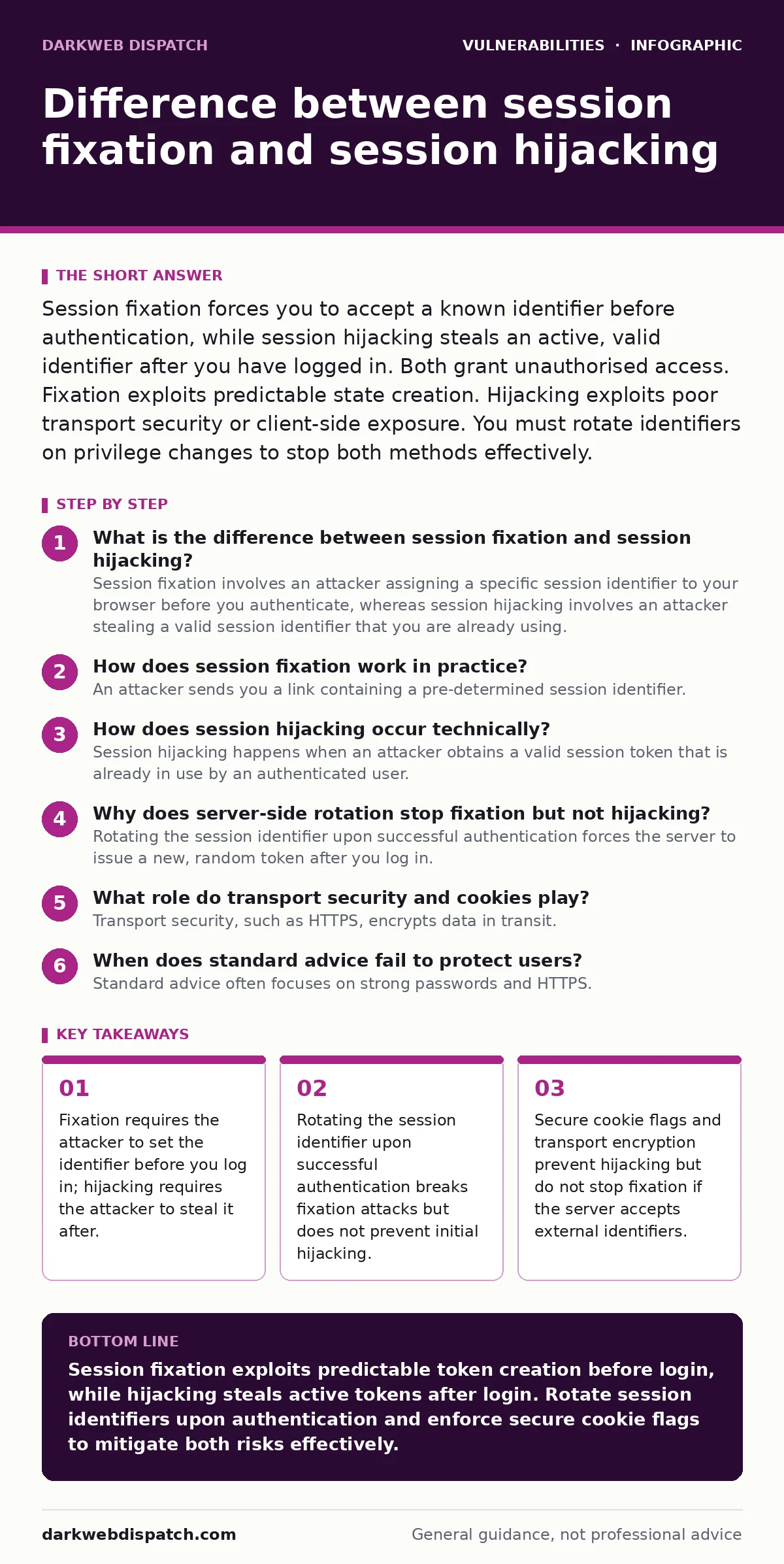
Session fixation forces you to accept a known identifier before authentication, while session hijacking steals an active, valid identifier after you have logged in. Both grant unauthorised access. Fixation exploits predictable state creation. Hijacking exploits poor transport security or client-side exposure. You must rotate identifiers on privilege changes to stop both methods effectively.
What is the difference between session fixation and session hijacking?
Session fixation involves an attacker assigning a specific session identifier to your browser before you authenticate, whereas session hijacking involves an attacker stealing a valid session identifier that you are already using. The core distinction lies in the timing of the compromise relative to your login process. In fixation, you unknowingly adopt the attacker’s token. In hijacking, the attacker intercepts or guesses your existing token. Both result in unauthorised access, but the defensive mechanisms differ significantly because the attack vectors target different stages of the session lifecycle.
How does session fixation work in practice?
An attacker sends you a link containing a pre-determined session identifier. When you click the link, the server creates a new session using that specific identifier instead of generating a random one. You then log in with your credentials. The server associates your authenticated user profile with that fixed identifier. The attacker, who already possesses the identifier, can now use it to access your account. This works because the server trusts the identifier provided in the initial request. The attack fails only if the server ignores client-provided identifiers or rotates the token upon authentication.
How does session hijacking occur technically?
Session hijacking happens when an attacker obtains a valid session token that is already in use by an authenticated user. This often occurs through network eavesdropping on unencrypted connections. It can also happen via cross-site scripting, where malicious code reads the token from your browser’s storage. Another method involves predicting the token if the server uses weak random number generation. Once the attacker has the token, they can present it to the server. The server treats the attacker as the legitimate user because the token matches an active, authenticated session.
Why does server-side rotation stop fixation but not hijacking?
Rotating the session identifier upon successful authentication forces the server to issue a new, random token after you log in. This renders the attacker’s pre-assigned token useless, effectively neutralising session fixation. However, this measure does not help against session hijacking. If an attacker steals your new, rotated token via network sniffing or client-side script, rotation offers no protection. The attacker still holds a valid, active token. Rotation addresses the trust of the initial token, not the secrecy of the ongoing token.
What role do transport security and cookies play?
Transport security, such as HTTPS, encrypts data in transit. This prevents attackers from reading session tokens as they travel between your browser and the server. Without encryption, hijacking via eavesdropping is trivial. Cookie flags add another layer of defence. The HttpOnly flag prevents client-side scripts from accessing the cookie, mitigating theft via cross-site scripting. The Secure flag ensures the cookie is only sent over encrypted connections. These measures are standard for preventing hijacking. They do not prevent fixation if the server accepts tokens via URL parameters or other non-cookie mechanisms.
| Attack Vector | Primary Goal | Defence Mechanism | Failure Condition |
|---|---|---|---|
| Session Fixation | Force known ID | Token rotation on login | Server accepts client ID |
| Session Hijacking | Steal active ID | Encryption and HttpOnly | Weak randomness or XSS |
See also: How to Spot JWT Vulnerabilities Before They Breach Your System · Prevent Microsoft Exchange Vulnerabilities: Priority Measures
When does standard advice fail to protect users?
Standard advice often focuses on strong passwords and HTTPS. These measures do nothing against session fixation if the application logic is flawed. Suppose an application allows session identifiers to be passed in URL query strings. Even with HTTPS, the token is visible in server logs, browser history, and referer headers. An attacker can harvest these tokens. Additionally, if an application does not implement input validation for session parameters, it may accept maliciously crafted identifiers. This creates a vulnerability that persists despite strong transport encryption. The flaw is in the application logic, not the transport layer.
How do related vulnerabilities complicate session security?
Session management rarely exists in isolation. If an application suffers from server-side template injection, an attacker might execute code that reads session variables directly. This bypasses network-level protections entirely. Similarly, directory listing exposure can reveal configuration files that contain session secrets or debugging information. While firmware vulnerabilities and IoT device vulnerabilities are distinct issues, they highlight how weak defaults in one area can compromise security in another. Emergency patching is often the response to such breaches, but it does not fix the underlying architectural trust issues that allow fixation or hijacking.
What steps stop both attack types effectively?
You must implement a defence-in-depth strategy. First, ensure all sessions use HTTPS to prevent network eavesdrocking. Second, set the HttpOnly and Secure flags on all session cookies. Third, and most critically, rotate the session identifier upon every privilege change, including login. Fourth, bind sessions to specific user attributes like IP address or user-agent string, though be aware this can break legitimate use cases like mobile networks. Finally, implement absolute and idle timeouts. If a session remains inactive for a set period, invalidate it. This reduces the window for hijacking. Regularly review your code for input validation errors that might allow external token injection.
Why is token entropy a hidden risk?
Session identifiers must be unpredictable. If a server uses a weak random number generator, an attacker can predict future tokens. This allows hijacking without stealing the current token. The attacker simply guesses the next valid identifier. This risk is often overlooked because the tokens look random to the human eye. Cryptographic strength is required, not just visual randomness. Low entropy in token generation turns session hijacking into a brute-force exercise that may succeed quickly. Ensure your framework uses a cryptographically secure pseudo-random number generator for all session IDs.
Key takeaways
- Fixation requires the attacker to set the identifier before you log in; hijacking requires the attacker to steal it after.
- Rotating the session identifier upon successful authentication breaks fixation attacks but does not prevent initial hijacking.
- Secure cookie flags and transport encryption prevent hijacking but do not stop fixation if the server accepts external identifiers.
Session fixation exploits predictable token creation before login, while hijacking steals active tokens after login. Rotate session identifiers upon authentication and enforce secure cookie flags to mitigate both risks effectively.
Frequently asked questions
Can I prevent session fixation by using long passwords?
No. Passwords authenticate your identity, but they do not change how the server manages session identifiers. Fixation exploits the session management logic, not the strength of your credentials. You must rotate the session token after login.
Does clearing my browser cookies stop session hijacking?
Clearing cookies terminates your current session, which stops an ongoing hijack. However, it does not prevent future hijacking if the underlying security flaws remain. The attacker can steal your new token as soon as you create a new session.
Is session fixation common in modern web frameworks?
Modern frameworks often mitigate fixation by default through automatic token rotation. However, custom implementations or legacy systems may still be vulnerable. You must verify that your application rotates tokens upon authentication and does not accept client-provided session IDs.
How do I detect if I am under a fixation attack?
Detection is difficult in real-time. Indicators include unexpected session starts or anomalies in user-agent strings. Server-side monitoring for multiple authentication attempts using the same session ID can reveal fixation patterns. Implementing strict logging helps identify these anomalies post-incident.
How this guide was produced: written by the DarkWeb Dispatch editorial team with AI assistance, checked against the public references listed below, and reviewed when the facts change. See our editorial policy or report an error.