Cloud Metadata Service Attacks: How to Block Credential Theft
Attackers bypass network rules by targeting the metadata endpoint directly from within the compromised instance, rendering external firewalls useless.

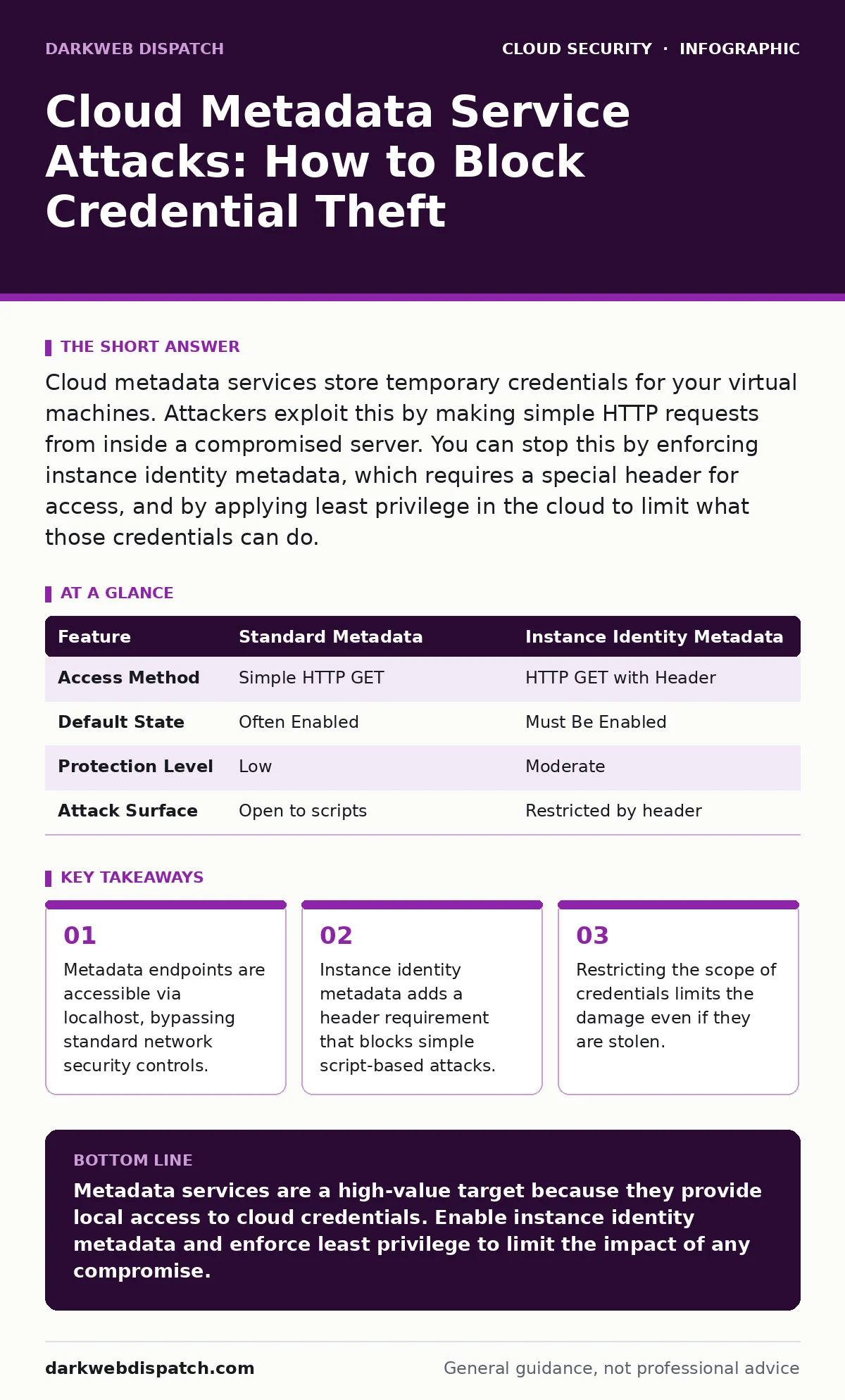
Cloud metadata services store temporary credentials for your virtual machines. Attackers exploit this by making simple HTTP requests from inside a compromised server. You can stop this by enforcing instance identity metadata, which requires a special header for access, and by applying least privilege in the cloud to limit what those credentials can do.
What is a cloud metadata service?
It is a local web server running on every virtual machine that provides configuration data and credentials. This service allows the operating system to identify itself and retrieve temporary access keys without storing secrets in code. You access it by sending an HTTP request to a specific local IP address, such as 169.254.169.254. This mechanism ensures that applications can interact with cloud resources securely, but it also creates a high-value target for attackers who gain access to the instance.
Why are metadata endpoints dangerous?
They expose temporary security credentials that grant access to other cloud services. An attacker who compromises a virtual machine can query this endpoint to obtain tokens for storage, databases, or management consoles. These tokens are often more powerful than the user account that launched the instance. Because the service runs locally, standard network firewalls cannot block access to it. This makes it a primary vector for lateral movement within a cloud environment.
How do attackers steal credentials from metadata?
They exploit server-side request forgery or run scripts that query the local endpoint. Imagine an attacker uploads a malicious script to a web server that processes user input. When a victim visits the page, the server fetches the metadata URL internally, returning the credentials to the attacker. This technique bypasses the need to interact with the endpoint from outside the machine. It turns the compromised server into a proxy for credential theft.
What is instance identity metadata?
It is a security feature that requires a specific header for accessing sensitive data. When enabled, the metadata service ignores requests that do not include the correct authorization header. This blocks simple scripts and basic server-side request forgery attempts that cannot append headers. You must configure your applications to include this header when they need to access credentials. This adds a layer of friction that stops automated attacks from succeeding immediately.
| Feature | Standard Metadata | Instance Identity Metadata |
|---|---|---|
| Access Method | Simple HTTP GET | HTTP GET with Header |
| Default State | Often Enabled | Must Be Enabled |
| Protection Level | Low | Moderate |
| Attack Surface | Open to scripts | Restricted by header |
Does network segmentation stop this attack?
No, because the connection happens entirely within the virtual machine. The traffic never leaves the local interface of the compromised instance. External firewalls and security groups are irrelevant to this specific attack vector. This is why you must combine network controls with host-level protections. Relying solely on network isolation creates a false sense of security against insider threats or compromised workloads.
See also: Policy as Code: Definition, Purpose and Practical Cloud Security · Bot Management FAQs: Distinguishing Humans from Automated Traffic
How do you limit the damage if credentials are stolen?
You apply least privilege in the cloud to restrict what the credentials can do. Instead of granting full administrative access, assign roles that only allow specific actions on specific resources. If an attacker steals a token, they can only perform the narrow set of actions permitted by that role. This containment strategy prevents them from escalating privileges or accessing unrelated data. It reduces the blast radius of any single compromise.
What are the risks of using static access keys?
Static keys never expire and often have broader permissions than necessary. If an attacker obtains a static key, they retain access indefinitely unless you manually revoke it. This contrasts with temporary credentials from metadata services, which expire automatically. Storing static keys in code or configuration files increases the risk of accidental exposure. You should treat static keys as high-risk secrets that require strict rotation and monitoring.
How does this relate to other cloud threats?
Metadata attacks often serve as the entry point for broader account compromise. Once an attacker has credentials, they may attempt SaaS account takeover to access productivity tools. They might also exploit OAuth token abuse to impersonate users across integrated applications. Understanding these connections helps you build a defence that covers multiple attack paths. A breach in one area can cascade into others if trust boundaries are not clearly defined.
What is the role of DevSecOps here?
It integrates security checks into the development pipeline to prevent misconfigurations. Developers can use scanning tools to detect code that queries metadata endpoints without proper headers. This catches vulnerabilities before the application reaches production. It shifts security responsibility left, reducing the chance of accidental exposure. Automated checks ensure that security standards are consistently applied across all deployments.
Can microsegmentation help prevent lateral movement?
Yes, by restricting communication between different parts of your infrastructure. Even if an attacker obtains credentials, microsegmentation limits which other systems they can reach. This containment prevents them from moving freely across your environment. It complements least privilege by adding network-level barriers. Together, these controls create multiple layers of defence that an attacker must breach.
Key takeaways
- Metadata endpoints are accessible via localhost, bypassing standard network security controls.
- Instance identity metadata adds a header requirement that blocks simple script-based attacks.
- Restricting the scope of credentials limits the damage even if they are stolen.
Metadata services are a high-value target because they provide local access to cloud credentials. Enable instance identity metadata and enforce least privilege to limit the impact of any compromise.
Frequently asked questions
Is metadata access blocked by default?
No, most cloud providers enable metadata access by default to ensure compatibility with older applications. You must explicitly configure instance identity metadata to add protection.
Do I need to change my application code?
Yes, if you enable instance identity metadata, your applications must include the required header in their requests. This is a small change that significantly improves security.
Can I use a VPN to protect metadata?
No, virtual private networks protect traffic between networks, not local connections. Metadata access occurs within the virtual machine, bypassing external network controls.
How often should I rotate static keys?
You should rotate static keys regularly, but it is better to use temporary credentials from metadata services instead. Temporary keys eliminate the need for manual rotation and reduce exposure risk.
How this guide was produced: written by the DarkWeb Dispatch editorial team with AI assistance, checked against the public references listed below, and reviewed when the facts change. See our editorial policy or report an error.